Every monsoon, hospitals across Delhi NCR see a sharp rise in dengue cases — and every year, the same confusion resurfaces among patients and families. Is a mild fever dengue or just a viral infection? Does a low platelet count always mean hospitalization? Should you start worrying the moment the fever starts, or wait a few days?
Dengue is not a disease you should manage on assumptions. Knowing exactly what to watch for — and more importantly, when to act — can make the difference between a smooth recovery at home and a medical emergency.
What Causes Dengue and How It Spreads
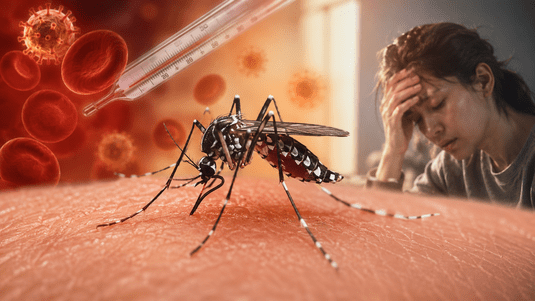
Dengue is caused by the dengue virus and transmitted by the bite of an infected female Aedes aegypti mosquito. Unlike malaria-carrying mosquitoes that bite at night, Aedes mosquitoes are aggressive daytime biters, most active during early morning and late afternoon. They breed in clean, stagnant water — flower pots, coolers, discarded tyres, water tanks — which is why dengue cases spike so sharply during and after monsoon rains, when stagnant water collects everywhere.
There are four distinct serotypes of the dengue virus (DENV-1 to DENV-4). Infection with one serotype gives lifelong immunity to that type only — which is why a person can get dengue more than once, and why a second infection with a different serotype can sometimes be more severe than the first.
Also Read : लू लगने के लक्षण, इलाज और बचाव | Heat Stroke in Hindi
Day-Wise Progression: What Happens in Your Body
Understanding the timeline of dengue helps you recognise which phase you are in and what to expect next.
Day 1–3: Febrile Phase
This is when most people first notice symptoms:
- Sudden high fever (often 102–104°F)
- Severe headache, especially behind the eyes
- Joint and muscle pain (dengue is historically called “breakbone fever” for this reason)
- Nausea, vomiting, or loss of appetite
- Skin rash may appear (flat, red patches)
During this phase, the virus is actively multiplying in the bloodstream. Most patients feel unwell but stable. This is also the window where mosquitoes biting the patient can spread the infection further, so staying under a mosquito net is important even for the patient.
Day 4–7: Critical Phase
This is the phase that requires the closest attention. As the fever starts to come down, many people mistakenly assume they are recovering — but this is often when complications begin:
- Plasma leakage can occur, leading to a drop in blood pressure
- Platelet counts typically fall to their lowest during this window
- Warning signs (detailed below) tend to appear here
- This phase usually lasts 24–48 hours and needs monitoring even if the patient feels okay
Day 7 onwards: Recovery Phase
If the critical phase passes without complications, fluid that leaked into tissues gets reabsorbed, platelet counts begin to rise, and energy levels gradually return. Full recovery, including complete normalisation of platelet count, can take one to two weeks.
Also Read : डिहाइड्रेशन के लक्षण, कारण और घरेलू इलाज
Platelet Count Myths — What You Actually Need to Know
This is where most panic and misinformation come from, so let’s be clear about the facts.
Myth 1: A low platelet count always means you need a transfusion.
False. Doctors don’t treat a number in isolation — they treat the patient. Platelet transfusions are only considered when the count drops to critically low levels (typically below 10,000–20,000/µL) or when there is active bleeding, not simply because the count is “low.” Many patients recover fully with platelet counts in the 20,000–50,000 range, monitored closely without any transfusion.
Myth 2: The lower the platelet count, the sicker the patient.
Not necessarily. Platelet count is one indicator among several — hematocrit (blood concentration), blood pressure, and clinical symptoms matter just as much, sometimes more. A patient with a platelet count of 40,000 who is stable and eating well may be in a far better position than a patient with 90,000 who is showing signs of plasma leakage.
Myth 3: Papaya leaf juice or kiwi will “boost” platelets and cure dengue.
There is no strong clinical evidence that papaya leaf extract meaningfully raises platelet counts or alters the course of the disease. Some patients report feeling better, but this is generally attributed to hydration and rest rather than any effect on platelet production. Home remedies should never replace monitoring and medical care.
Myth 4: Once the fever breaks, the danger is over.
This is one of the most dangerous misconceptions. As explained above, the critical phase often begins right as the fever subsides. This is precisely when families relax — and precisely when close monitoring matters most.
Also Read : डिहाइड्रेशन के लक्षण, कारण और घरेलू इलाज
Warning Signs That Mean You Should Go to the Hospital Immediately
Do not wait for these to worsen. Seek emergency care if you or a family member experiences:
- Severe abdominal pain or persistent tenderness
- Persistent vomiting (three or more episodes in 24 hours)
- Bleeding from gums, nose, or blood in vomit/stool
- Rapid breathing or difficulty breathing
- Marked fatigue, restlessness, or irritability
- Cold, clammy skin or a noticeable drop in urine output
- Sudden drop in body temperature after a high fever, accompanied by weakness
These signs can indicate the onset of Dengue Hemorrhagic Fever (DHF) or Dengue Shock Syndrome (DSS) — serious complications that require immediate hospital-based management, including IV fluids and close monitoring.
Also Read : Vitamin B12 Deficiency: Causes, Symptoms, and Treatment
Home Care During Mild Dengue
If a doctor has confirmed dengue and advised home monitoring rather than admission, the following steps support recovery:
- Rest as much as possible — the body needs energy to fight the virus
- Stay well-hydrated with ORS, coconut water, and clear fluids
- Take paracetamol for fever and pain — never NSAIDs like ibuprofen or aspirin, as these increase bleeding risk
- Monitor temperature and watch closely for warning signs, especially as fever begins to subside
- Get platelet and hematocrit counts checked as advised by your doctor, typically every 24 hours during the critical phase
- Use mosquito nets or repellents to prevent transmission to others in the household
Preventing Dengue: Practical Steps for Monsoon
- Empty and clean water containers, coolers, and flower pots at least once a week
- Cover water storage tanks and drums completely
- Use mosquito repellents, especially during early morning and dusk
- Wear full-sleeved clothing when outdoors during peak mosquito activity
- Report stagnant water in your neighbourhood to the local municipal authorities
Conclusion
Dengue is manageable when monitored correctly, but the details matter — which day you’re on, what your platelet trend looks like alongside your symptoms, and recognising the warning signs that separate routine monitoring from a medical emergency. Don’t rely on assumptions or home remedies to gauge severity. If you or a family member develops a high fever during the monsoon season, get tested early, follow your doctor’s monitoring schedule, and know exactly which symptoms mean it’s time to go to the hospital.
FAQs
Q1. How is dengue diagnosed?
Through blood tests — NS1 antigen test (detects the virus in the first few days of fever) and IgM/IgG antibody tests (useful after day 5).
Q2. What is a safe platelet count for dengue?
There’s no single “safe” number — doctors assess platelet count alongside hematocrit, blood pressure, and symptoms. Transfusion is considered only in specific clinical situations, not based on the number alone.
Q3. Can dengue happen twice?
Yes. There are four dengue serotypes, and infection with one gives immunity only to that type. A second infection with a different serotype can sometimes be more severe.
Q4. Is hospitalization always required for dengue?
No. Many cases are managed at home with rest, hydration, and monitoring. Hospitalization is needed if warning signs appear or platelet/hematocrit trends indicate risk.
Q5. How long does recovery from dengue take?
The acute illness typically resolves in 7–10 days, but fatigue and full platelet recovery can take one to two additional weeks.