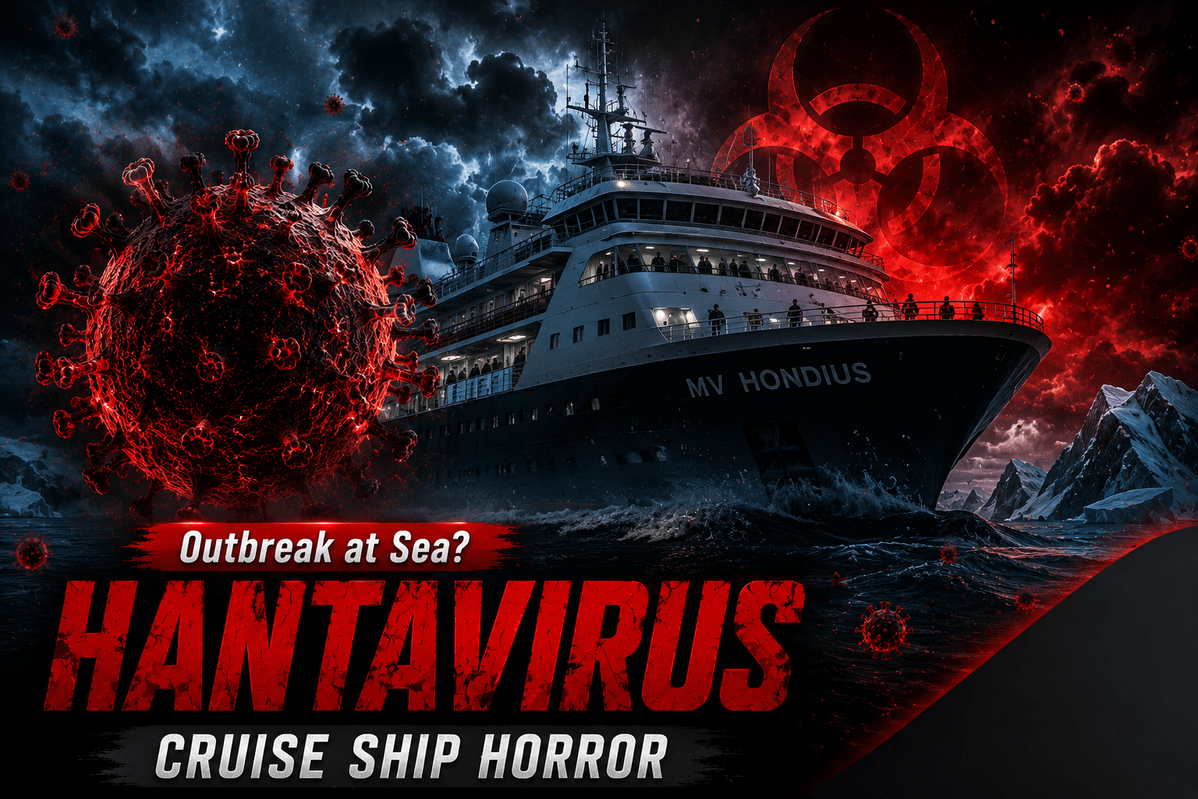
A deadly virus has made headlines around the world in May 2026 — and this time, it began on a cruise ship in the middle of the Atlantic Ocean. The outbreak of Hantavirus, specifically the rare Andes strain, on board the Dutch expedition vessel MV Hondius has prompted emergency evacuations, international monitoring, and a flood of questions: What is Hantavirus? How does it spread? And should people in India be concerned?
Here is everything you need to know, explained clearly.
What Is Hantavirus?
Hantavirus is a group of RNA viruses carried primarily by rodents such as rats and mice. Humans typically get infected by inhaling tiny particles — aerosols — from the urine, droppings, or saliva of infected rodents. In general, Hantavirus isn’t transmitted from one person to another.
There are two main diseases caused by Hantavirus:
1. Hantavirus Pulmonary Syndrome (HPS) This form is seen mainly in North and South America. It causes severe respiratory illness and can be life-threatening. The Andes virus — responsible for the 2026 cruise ship outbreak — causes HPS and is the only known strain capable of limited human-to-human transmission.
2. Hemorrhagic Fever with Renal Syndrome (HFRS) This form is more common in Europe and Asia, including parts of India. It affects the kidneys and blood vessels, with mortality rates reaching up to 15% in severe cases.
The 2026 Hantavirus Outbreak: What Happened on MV Hondius?
The current global concern traces back to a single expedition cruise ship. Here is a timeline of what unfolded:
- 1 April 2026 — The Dutch-flagged vessel MV Hondius departs from Ushuaia, Argentina, with 147 passengers and crew from 23 nationalities on board. The ship was destined for Antarctica and remote South Atlantic islands.
- Mid-April — An elderly Dutch passenger develops symptoms and later dies. His wife disembarks at Saint Helena and passes away in a hospital in Johannesburg, South Africa, on 26 April.
- 2 May 2026 — The World Health Organization (WHO) is formally notified of a cluster of severe respiratory illness on board.
- 6 May 2026 — WHO confirms the Andes strain of Hantavirus as the cause of the outbreak.
- 10 May 2026 — The ship docks at Tenerife, Spain’s Canary Islands. Passengers from 23 countries are evacuated in full protective gear and flown home for monitoring.
- 11 May 2026 — 18 American passengers arrive at the University of Nebraska Medical Center. One tests positive; another shows symptoms. As of this date, 11 confirmed or probable cases have been reported, with 3 deaths.
Investigations suggest the index case — a Dutch passenger — may have been exposed to infected rodents during a months-long road trip through Argentina, Chile, and Uruguay before boarding the ship.
Hantavirus Symptoms: What to Watch For
The symptoms of Hantavirus infection (HPS) typically appear within 4 to 42 days after exposure. The disease often progresses in two distinct phases:
Early Phase (Days 1–5)
- High fever (38–40°C)
- Fatigue and body aches
- Headache
- Nausea, vomiting, and diarrhea
- Abdominal pain
Late Phase (After Day 5)
- Severe shortness of breath
- Fluid accumulation in the lungs
- Rapid drop in blood pressure
- Acute Respiratory Distress Syndrome (ARDS)
- Organ failure in critical cases
Important: Early symptoms resemble common flu or gastroenteritis. Anyone who has traveled to South America recently and develops these symptoms should seek medical attention immediately and inform their doctor of their travel history.
Also Read : टाइफाइड के लक्षण, इलाज और परहेज
How Does Hantavirus Spread?
Understanding transmission is key to understanding why global health agencies are not declaring a pandemic.
Primary Route — Rodent to Human: Breathing in aerosols from rodent droppings, urine, or saliva. This is how the vast majority of cases occur worldwide.
Human-to-Human (Andes Virus Only): The Andes strain — confirmed in the 2026 outbreak — is the only Hantavirus known to spread between people. However, this requires prolonged, close contact with a symptomatic person, such as extended time in enclosed spaces, direct physical contact, or exposure to saliva and respiratory secretions.
As Nebraska health official Christine Freeman stated during a press briefing: “The Andes variant does not spread easily, and it requires prolonged, close contact with someone who’s already sick.”
Is Hantavirus Dangerous? What Are the Survival Chances?
Hantavirus is not a virus to take lightly. Among patients who develop full HPS with severe respiratory symptoms, the case fatality rate is estimated at approximately 38%, according to the CDC. However, survival odds improve significantly with early medical intervention. In severe cases, extracorporeal membrane oxygenation (ECMO) — a machine that temporarily takes over heart and lung function — can improve survival rates to around 80% when initiated early.
This is why doctors stress that early presentation to a hospital is critical.
Expert Speak
Dr. Sanjay Mahajan, Sr. Consultant Physician & Intensivist – Kailash Hospital, Noida, advises caution without panic:
“Hantavirus is a serious infection, but it behaves very differently from viruses like COVID-19. It does not spread through casual contact or via airborne droplets in the way respiratory viruses do. For the Indian general population, the risk is currently very low. However, anyone returning from South America with fever and breathing difficulty must consult a doctor immediately and disclose their travel history. Early diagnosis saves lives.”
Also Read : लू लगने के लक्षण, इलाज और बचाव | Heat Stroke in Hindi
Hantavirus in India — Is There a Risk?
This is the question most Indians are searching for right now. The reassuring answer is: No confirmed Hantavirus cases linked to the 2026 outbreak have been reported in India.
A report by Elara Capital confirmed that Hantavirus risk in India remains low, and its limited transmissibility means outbreaks are generally localised and self-limiting. India does have rodent populations that carry certain Hantavirus strains, but the Andes virus — the aggressive, person-to-person variant — is linked specifically to rodents in South America and has not been found in India.
The WHO currently assesses the global risk from the MV Hondius event as low, and the WHO Director-General has publicly urged the public not to panic: “Based on scientific assessment and based on evidence, the risk is low. They shouldn’t worry.”
Who should be extra cautious in India?
- Travellers who have recently returned from Argentina, Chile, or Uruguay
- Anyone who was on board MV Hondius or shared a flight with a confirmed case
- Healthcare workers treating suspected imported cases
Is This the Next COVID-19?
Multiple global health experts have drawn a firm line between Hantavirus and COVID-19. Former FDA Commissioner Scott Gottlieb noted that Hantavirus “is not going to spread like a pandemic virus, like COVID,” because it moves far less efficiently between people. Three key differences stand out:
- Transmission requires close, sustained contact — not brief or casual interaction
- It does not spread through the air the way COVID or influenza does
- Outbreaks have historically remained localised and self-limiting
The WHO echoed this sentiment: “This is not another COVID-19.”
Also Read : डिहाइड्रेशन के लक्षण, कारण और घरेलू इलाज
Prevention: How to Protect Yourself
There is currently no licensed vaccine or specific antiviral treatment for Hantavirus. Prevention is therefore the most powerful tool available.
General Prevention:
- Avoid contact with wild rodents, their nests, and droppings
- Never dry sweep areas with rodent activity — use wet disinfectant methods and wear gloves
- Store food in sealed, rodent-proof containers
- Seal gaps and holes in your home where rodents may enter
For Travellers to South America:
- Avoid areas with high rodent activity, especially remote rural or forested zones
- Do not handle dead rodents
- If you develop fever, fatigue, or breathlessness within 6 weeks of returning, seek medical care immediately and mention your travel history
In Healthcare Settings: For suspected Andes virus cases, the CDC recommends airborne infection isolation rooms, N95 or higher respirators, gown, gloves, and eye protection.
When to See a Doctor
Seek immediate medical attention if you have:
- Recently travelled to South America (within the last 6 weeks)
- Sudden high fever with body aches followed by difficulty breathing
- Been in close contact with a confirmed Hantavirus case
At Kailash Hospital, Noida, our infectious disease and internal medicine teams are equipped to evaluate and manage cases involving travel-related infections. If you have concerns after returning from abroad, do not delay consultation.
Frequently Asked Questions (FAQ)
Q1. What is the Hantavirus outbreak in 2026 about? In April–May 2026, an outbreak of the Andes strain of Hantavirus was identified on board the Dutch cruise ship MV Hondius. The ship had departed from Argentina and carried passengers from 23 countries. As of May 12, 2026, there are 11 confirmed or probable cases and 3 deaths. WHO has assessed global public risk as low.
Q2. Has Hantavirus been reported in India in 2026? No. There are no confirmed Hantavirus cases linked to the 2026 outbreak reported in India. Indian health authorities and the WHO consider the risk to the Indian general population to be very low at this time.
Q3. What are the main symptoms of Hantavirus? Early symptoms include high fever, fatigue, headache, nausea, and body aches. These can rapidly progress to severe shortness of breath, fluid in the lungs, and in critical cases, respiratory failure. Symptoms appear 4 to 42 days after exposure.
Q4. Can Hantavirus spread from person to person? Most Hantavirus strains do not spread between humans. The Andes strain — responsible for the 2026 outbreak — is the only known exception, but even this requires prolonged close contact with a symptomatic person. It does not spread through casual contact or breathing the same air briefly.
Q5. Is there a treatment or vaccine for Hantavirus? There is currently no WHO or USFDA-approved vaccine or specific antiviral treatment for Hantavirus. Treatment is supportive — oxygen therapy, mechanical ventilation, and in severe cases, ECMO (extracorporeal membrane oxygenation). Early hospitalisation significantly improves survival chances.
Q6. Should I be worried about Hantavirus if I haven’t travelled abroad? If you have not recently travelled to South America and have not been in contact with a confirmed case, your risk is extremely low. Continue normal hygiene practices, avoid rodent contact, and monitor credible health news for updates.
The Bottom Line
The 2026 Hantavirus outbreak is a serious but contained event. Global health agencies are responding swiftly, and the risk to the Indian public remains very low. Unlike COVID-19, Hantavirus does not spread through the air in routine settings and requires close, sustained contact for person-to-person transmission. Stay informed, avoid rodent exposure, and seek prompt medical care if you have travelled to affected regions and develop symptoms.