The message came too late. In June 2025, 22-year-old kabaddi player Brijesh Solanki rescued a stray puppy — and ignored the bite. No wound wash. No vaccine. Within weeks, he was dead. Around the same time, a 14-year-old boy in Madhya Pradesh died after receiving only one dose of the rabies vaccine — skipping immunoglobulin and the remaining shots.
Both deaths share one common thread: delay and incomplete treatment.
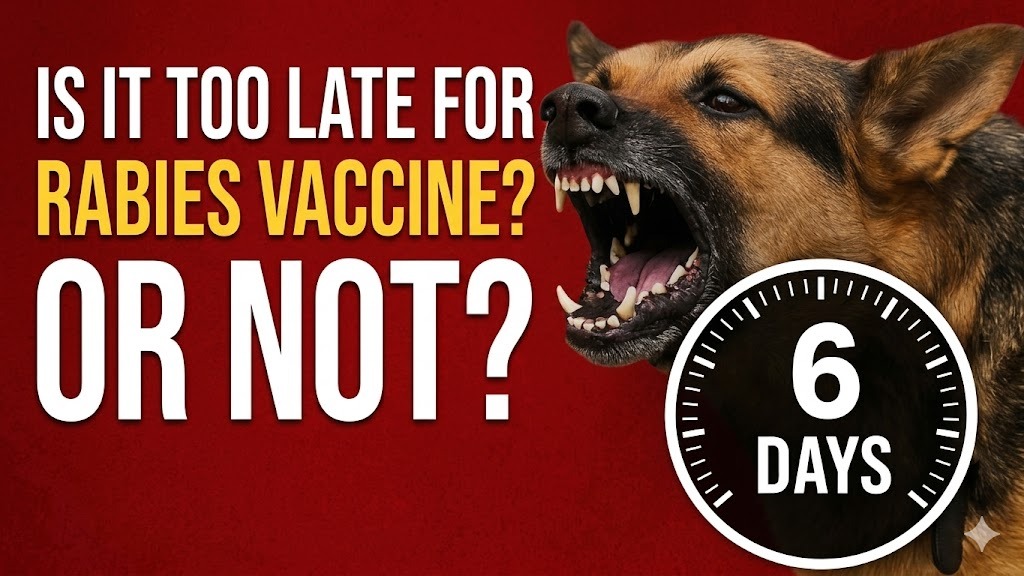
Every year, thousands of Indians ask the same terrifying question after a dog bite — “Kya 24 ghante baad bhi vaccine lene ka koi fayda hai?” Or worse — they wait days before going to a hospital, hoping the wound heals on its own.
Dr. Sarika Chandra, CCMO/DYMS at Kailash Hospital, Noida, addresses this with clinical urgency: “There is no safe window to wait. Whether it’s been 2 hours or 72 hours since a dog bite, you must go to a hospital immediately. Rabies does not give second chances — but medicine does, if you act in time.”
This guide answers everything: what happens if you delay, whether dog bite treatment after 24 hours still works, and what the correct rabies vaccine schedule actually looks like.
Table of Contents
- What Happens in Your Body After a Dog Bite?
- Dog Bite Treatment After 24 Hours — Is It Too Late?
- WHO Dog Bite Categories — Which Bites Are Truly Dangerous?
- Rabies Vaccine Schedule After Dog Bite — Day 0, 3, 7, 14 Explained
- Signs That a Dog Bite Is a Medical Emergency
- Real Cases: What Happened When People Delayed Treatment
- Dog Bite Treatment at Kailash Hospital, Noida
- FAQs
What Happens in Your Body After a Dog Bite?
When a rabid animal bites you, the rabies virus enters through the wound and begins replicating silently in the muscle tissue. There are no symptoms at this stage. This is called the incubation period — and it can last anywhere from 5 days to over a year depending on:
- Location of the bite: Face, neck, and hand bites are far more dangerous — the virus reaches the brain faster.
- Depth of the wound: Deep puncture wounds carry a higher viral load.
- Age of the victim: Children have shorter nerve pathways — onset can be faster.
- Whether the animal was vaccinated: Stray dogs with no vaccination history = maximum risk.
The virus travels along nerve fibres toward the spinal cord and brain at approximately 1–2 cm per day. Once it reaches the brain, no treatment in the world can save you.
This is exactly why the first 24–72 hours after a dog bite are medically critical — not the days when symptoms appear.
Dog Bite Treatment After 24 Hours — Is It Too Late?
No. It is not too late — but every hour of further delay increases the risk.
This is the most misunderstood fact about rabies prevention in India. Many people believe that if 24 hours have passed, the vaccine will no longer work. This is medically incorrect.
Post-Exposure Prophylaxis (PEP) — the rabies vaccine series given after a bite — remains effective even if started 2, 3, or even 7 days after the bite, provided the person has not yet developed symptoms.
Dr. Sarika Chandra explains: “The rabies virus travels slowly through the nervous system. During this incubation window — which can last weeks to months — PEP can still neutralize the virus before it reaches the brain. But once neurological symptoms begin, the disease becomes virtually 100% fatal. That window is your only chance.”
What changes when you delay:
| Time Since Bite | PEP Effectiveness | Additional Requirement |
|---|---|---|
| 0–24 hours | Highest | Wound wash + Vaccine + RIG if needed |
| 24–72 hours | Still highly effective | Wound assessment + Full vaccine schedule |
| 3–7 days | Effective if no symptoms | Immunoglobulin (RIG) mandatory for deep bites |
| 7–14 days | Decreasing but still recommended | Hospital admission + Monitoring |
| Symptoms present | No treatment is effective | Palliative care only |
The bottom line: If you were bitten yesterday, last week, or even 10 days ago — go to a hospital today. Do not wait another hour.
WHO Dog Bite Categories — Which Bites Are Truly Dangerous?
The World Health Organization classifies animal exposures into three categories. Your treatment depends on which category your bite falls under:
| Category | Type of Exposure | Treatment Required |
|---|---|---|
| Category I | Touching/feeding animal, licks on intact skin | Wash hands thoroughly — no vaccine needed |
| Category II | Minor scratches, nibbles, abrasions without bleeding | Wound wash + Rabies vaccine series (PEP) |
| Category III | Deep puncture wounds, multiple bites, licks on broken skin, bites on face/neck/hands | Immediate wound care + Full PEP + Rabies Immunoglobulin (RIG) |
“Most patients who come in late are Category III cases who thought they were Category I,” notes Dr. Chandra. “A scratch that barely bled, a lick over a small cut — people dismiss these. But if the animal was infected, even minor contact is enough.”
High-risk dog profiles in India:
- Unvaccinated stray dogs
- Dogs that were recently sick or behaving abnormally
- Dogs that bit without provocation
- Dogs that have since died or disappeared
Rabies Vaccine Schedule After Dog Bite — Day 0, 3, 7, 14 Explained
India follows the WHO-recommended Post-Exposure Prophylaxis (PEP) protocol. Here is the complete schedule:
Intramuscular Vaccine Schedule (IM):
| Day | Dose |
|---|---|
| Day 0 (day of bite/first visit) | 1 full dose in the deltoid |
| Day 3 | 1 full dose |
| Day 7 | 1 full dose |
| Day 14 | 1 full dose (immunocompromised patients only — Day 28 booster also recommended) |
Intradermal Vaccine Schedule (ID) — More Common in India:
| Day | Sites |
|---|---|
| Day 0 | 4 sites (both deltoids + both thighs) |
| Day 3 | 4 sites |
| Day 7 | 4 sites |
| Day 28 | 2 sites (booster) |
“India shifted to the intradermal method because it cuts vaccine cost by nearly 80%,” explains Dr. Chandra. “It’s equally effective and has made PEP accessible in rural and semi-urban areas. But the schedule must be completed — stopping after one or two doses is one of the most common reasons treatment fails.”
What Is Rabies Immunoglobulin (RIG)?
For Category III bites — deep wounds, multiple bites, bites on the face or neck — the vaccine alone is not enough. Rabies Immunoglobulin (RIG) is injected directly into and around the wound on Day 0. It provides immediate, passive antibody protection while the vaccine builds your own immune response.
“The Madhya Pradesh boy who died? He received injections but not RIG. For a deep bite, skipping immunoglobulin is like locking the front door but leaving the back window wide open,” Dr. Chandra cautions.
Signs That a Dog Bite Is a Medical Emergency
Rush to the emergency department immediately if:
- The bite is on the face, neck, head, or hands
- There are multiple wounds from the same animal
- The wound is deep or heavily bleeding
- The dog was behaving strangely — running in circles, foaming, unprovoked aggression
- The dog has since died or disappeared
- The child is under 15 years — shorter nerve pathways mean faster viral progression
- You are immunocompromised — on steroids, HIV-positive, on chemotherapy
- More than 7 days have passed since the bite and you still haven’t received a vaccine
Any of the above conditions qualifies as a medical emergency. Do not attempt home treatment. Do not apply turmeric or chilli powder to the wound — these traditional remedies delay proper care and increase infection risk.
Real Cases: What Happened When People Delayed Treatment
Case 1: Brijesh Solanki, 22, Kabaddi Player
Brijesh Solanki was bitten by a puppy he had rescued. Considering it a minor wound, he took no medical action. Weeks later, he developed classic hydrophobia — violent spasms at the sight of water — and died. He was 22 years old, physically fit, with a career ahead of him. A 15-minute hospital visit on Day 0 would have saved his life.
Case 2: 14-Year-Old Boy, Rewa, Madhya Pradesh
This teenager received one vaccine injection after a dog bite but did not return for subsequent doses — and critically, did not receive Rabies Immunoglobulin for what was a deep Category III wound. He died 53 days after the bite, having developed full neurological symptoms despite partial vaccination.
“These are not rare stories. These are happening every week across India,” says Dr. Chandra. “The common thread is a belief that the wound looked minor or that they had time. Rabies does not care how the wound looks.”
Dog Bite Treatment at Kailash Hospital, Noida
At Kailash Hospital, Noida, the Emergency Medical Services department handles dog bite cases with a structured, WHO-compliant protocol:
Step 1 — Immediate Wound Management: Thorough washing with soap and running water for minimum 15 minutes, followed by povidone-iodine application, wound assessment, and sterile dressing.
Step 2 — Category Assessment Every patient is evaluated for bite location, wound depth, animal vaccination status, and time elapsed since injury to determine the correct PEP protocol.
Step 3 — Vaccine + RIG Administration Same-day administration of the first vaccine dose. For Category III bites, Human Rabies Immunoglobulin (HRIG) is infiltrated into the wound site and surrounding tissue on Day 0.
Step 4 — Tetanus Prophylaxis + Antibiotics: Tetanus toxoid is administered where indicated. Antibiotics are prescribed for infected or heavily contaminated wounds.
Step 5 — Follow-Up Tracking “We use reminder systems to ensure patients return on Day 3, Day 7, and Day 14,” says Dr. Chandra. “Incomplete vaccination is a medical failure — we take it seriously.”
If you or someone you know has been bitten by a dog, cat, monkey, or any stray animal — walk into the Emergency Department at Kailash Hospital, Sector 27, Noida or call +(91)-(0120)-2444444 without delay.
Also read: Vitamin B12 Deficiency: Causes, Symptoms, and Treatment
Conclusion
Rabies is the only disease in the world with a near-100% fatality rate once symptoms appear — and simultaneously one of the most preventable diseases when treated on time.
Dog bite treatment after 24 hours absolutely still works. Dog bite treatment after 72 hours still works. But every passing day without PEP narrows your window and raises your risk.
Brijesh Solanki didn’t need to die. The 14-year-old boy in MP didn’t need to die. Their tragedies are the clearest possible warning for every person who sees a dog bite as something to “wait and watch.”
As Dr. Sarika Chandra puts it: “A dog bite is not a wound — it is a medical countdown. The moment it happens, your clock starts. Wash immediately. Get to a hospital. Complete every single dose. At Kailash Hospital, we’ve seen lives saved at 12 hours and lives lost at 12 days. The difference is always the same: one decided to wait, the other didn’t.”
Don’t wait for symptoms. Rush to Kailash Hospital, Noida, immediately after any animal bite.
FAQs
Q1. Kya 24 ghante baad rabies vaccine effective hoti hai? Haan, bilkul hoti hai. Jab tak symptoms nahi aaye hain, Post-Exposure Prophylaxis (PEP) effective rehti hai. 24 ghante, 48 ghante, ya 7 din baad bhi — hospital jaana zaroor chahiye aur vaccine leni chahiye.
Q2. Kya sirf ek dose kaafi hai dog bite ke liye? Nahi. Ek dose partial protection deti hai lekin puri nahi. WHO protocol ke anusar 3–4 doses zaroor leni chahiye — Day 0, Day 3, Day 7, aur agar zarurat ho toh Day 14 par bhi.
Q3. Rabies immunoglobulin (RIG) kab di jaati hai? RIG sirf Category III bites mein di jaati hai — deep wounds, multiple bites, ya bites on face/neck/hands. Yeh Day 0 par hi deni hoti hai — baad mein dene se koi fayda nahi hota.
Q4. Kya vaccinated dog ke kaatne par bhi vaccine leni chahiye? Agar dog ka vaccination record verified hai aur last vaccine 1 saal se kam purani hai, toh risk low hai. Lekin wound care aur doctor consultation hamesha zaroor honi chahiye.
Q5. Kya puraane ghao (10–15 din baad) par bhi treatment hoti hai? Haan — jab tak neurological symptoms (hydrophobia, aerophobia, confusion) shuru nahi hue hain, PEP dena still recommended hai. Poori doctor assessment zaroori hai.
Q6. Dog bite ke turant baad ghar par kya karein? Sabse pehle wound ko saabun aur paani se 15 minute tak acche se dhoyein. Antiseptic lagaayein. Aur foran hospital jaayein — ghar par ruknaa ya koi desi nuskha aazmaana bilkul mat karein.