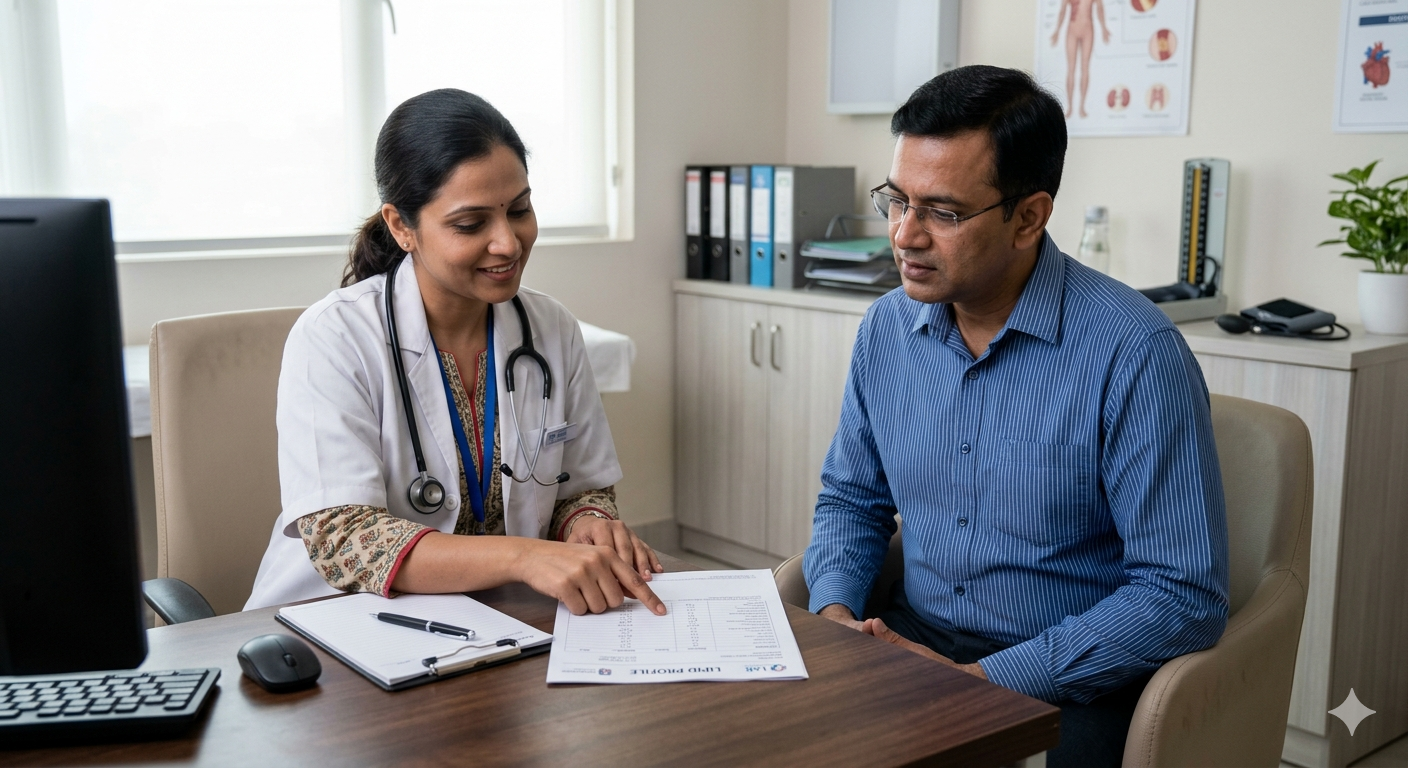
If your doctor has asked you to get a lipid profile test done, you may be looking at numbers — LDL, HDL, Total Cholesterol, Triglycerides — and wondering what they mean for you specifically as an Indian.
Here is what most generic health articles do not tell you: the cholesterol thresholds that apply to Western populations are not always safe for Indians. Indian guidelines now recommend stricter LDL targets, and for good reason.
This article uses the latest data from the Cardiological Society of India (CSI), the Lipid Association of India (LAI), ICMR-funded studies, and published research in The Lancet to give you an accurate, India-specific cholesterol reference guide.
Why Cholesterol Matters More for Indians
Cardiovascular diseases now account for a quarter of all mortality in India. Compared with people of European ancestry, CVD affects Indians at least a decade earlier — in their most productive midlife years. In Western populations, only 23% of CVD deaths occur before age 70; in India, that figure is 52%. AHA Journals
An ICMR-INDIAB nationwide study across 1,13,043 individuals showed that the overall prevalence of dyslipidemia in India stands at 81.2%. Low HDL cholesterol was the most common abnormality, with a prevalence of 66.9%. PubMed Central
This means that for most Indians, cholesterol is not just a number on a report — it is an active, ongoing risk that needs monitoring.
What Is a Lipid Profile Test?
A lipid profile (also called a lipid panel) measures four key values in your blood:
- Total Cholesterol — overall cholesterol in the bloodstream
- LDL (Low-Density Lipoprotein) — “bad” cholesterol; builds up in artery walls
- HDL (High-Density Lipoprotein) — “good” cholesterol; helps remove LDL from blood
- Triglycerides — a type of blood fat linked to diet and metabolic risk
In a significant shift, the CSI’s new guidelines now recommend non-fasting lipid measurements for risk estimation and treatment — departing from the traditional requirement of a 12-hour fasting blood draw — making testing more accessible for everyday patients.
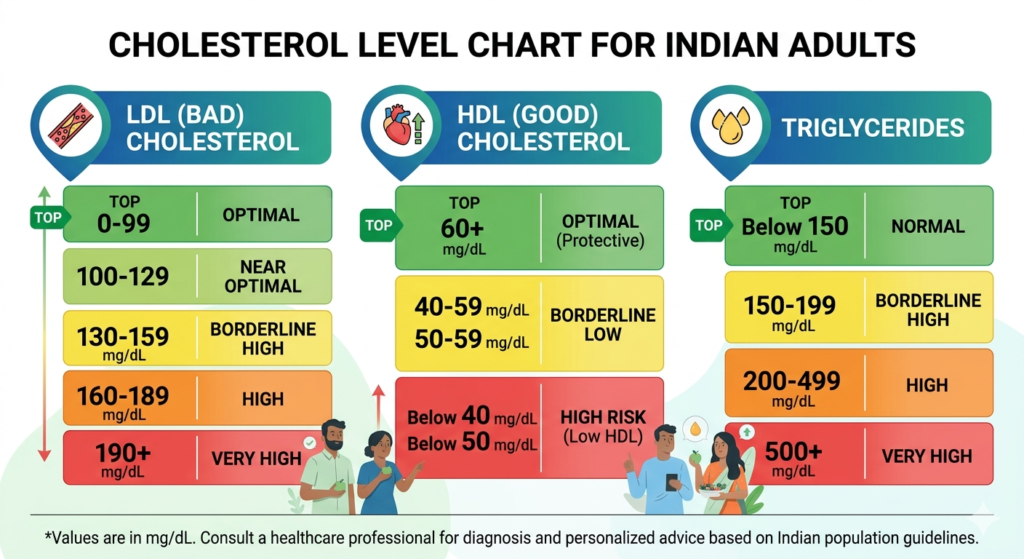
Cholesterol Level Chart for Indians (CSI 2024 Guidelines)
The Cardiological Society of India released India’s first-ever national guidelines for dyslipidemia management in 2024, developed by 22 senior cardiologists over four years. These are the most relevant reference values for Indian patients today.
Total Cholesterol
| Category | Total Cholesterol (mg/dL) |
|---|---|
| Desirable | Less than 200 |
| Borderline High | 200 – 239 |
| High | 240 and above |
LDL Cholesterol (Bad Cholesterol) — Risk-Based Indian Targets
The CSI recommends that the general population and low-risk individuals maintain LDL-C levels below 100 mg/dL and non-HDL-C below 130 mg/dL. High-risk individuals — such as those with diabetes or hypertension — should aim for LDL-C below 70 mg/dL. Very high-risk patients, including those with a history of heart attacks, angina, stroke, or chronic kidney disease, should target LDL-C below 55 mg/dL and non-HDL below 85 mg/dL. ThePrint
| Risk Category | LDL Target (mg/dL) | Who Falls Here |
|---|---|---|
| Low Risk | Below 100 | Healthy adults, no major risk factors |
| Moderate Risk | Below 100 | Smokers, mild hypertension |
| High Risk | Below 70 | Diabetes, hypertension, family history of CAD |
| Very High Risk | Below 55 | History of heart attack, stroke, angina, CKD |
HDL Cholesterol (Good Cholesterol)
For South Asians, the Indian Heart Association recommends an HDL goal of 50–60 mg/dL, given their elevated cardiovascular risk — higher than the threshold of 40 mg/dL typically used for non-South Asian populations. For every 10-point increase in HDL, the risk of heart disease reduces by half.
| HDL Level | Interpretation |
|---|---|
| Below 40 mg/dL (men) / Below 50 mg/dL (women) | Low — increased heart risk |
| 50 – 59 mg/dL | Acceptable |
| 60 mg/dL and above | Optimal (protective) |
Triglycerides
| Triglyceride Level | Category |
|---|---|
| Below 150 mg/dL | Normal |
| 150 – 199 mg/dL | Borderline High |
| 200 – 499 mg/dL | High |
| 500 mg/dL and above | Very High — urgent medical attention needed |
For patients with triglycerides above 150 mg/dL, the CSI recommends non-HDL cholesterol as the primary treatment target, rather than LDL alone.
People Also Read: Why Does Chest Pain Occur? Causes, Symptoms & When to See a Doctor
Why Indians Need Stricter Targets Than Western Guidelines Suggest
Most online cholesterol charts are based on American Heart Association (AHA) or European guidelines. These do not fully account for the unique metabolic profile of South Asians.
LDL and total cholesterol levels among Indians are similar to those of white populations, but HDL levels tend to be lower and triglycerides higher — a pattern that significantly increases cardiovascular risk at the same LDL value.
While traditional risk factors account for a significant portion of the risk in the population, the levels at which these factors come into play vary for Indians compared to other groups. Nearly two-thirds — 62% — of all cardiovascular deaths in Indian populations are premature.
This is why Indian cardiologists now follow stricter LDL targets, especially for younger patients and those with even mild metabolic risk factors.
The Most Common Cholesterol Problem in India Is Not What You Think
Most people assume “high cholesterol” means high LDL. In India, the picture is more complex.
Population-based studies show that the most common dyslipidemia patterns in India are borderline-high LDL cholesterol, low HDL cholesterol, and elevated triglycerides. High cholesterol is present in 25–30% of urban and 15–20% of rural subjects — but over a 20-year period, total cholesterol, LDL, and triglyceride levels have all increased among urban populations.
Low HDL is the most prevalent problem — meaning many Indians have “normal” LDL but dangerously low protective cholesterol, which is equally dangerous.
Clinical Insight: What We See at Kailash Hospital, Noida
At the Cardiology Department of Kailash Hospital, Noida, our team regularly evaluates patients with lipid abnormalities across age groups. A pattern observed commonly in clinical practice mirrors national data — many patients, including those in their 30s and 40s, present with apparently borderline LDL levels but critically low HDL and elevated triglycerides. This combination, often associated with abdominal obesity, insulin resistance, and sedentary habits, carries significant cardiovascular risk that a simple total cholesterol number would completely miss.
This is why a full lipid panel — not just total cholesterol — is essential, and why the risk-stratified targets in the CSI 2024 guidelines represent such an important step forward for Indian patients.
— Cardiology Team, Kailash Hospital, Noida
How Often Should You Get Your Cholesterol Checked?
The CSI guidelines recommend the first lipid profile at age 18, or earlier if there is a positive family history of cardiovascular disease or early-onset heart disease in the family. Medical Dialogues
| Age Group | Recommended Frequency |
|---|---|
| 18 – 35 years (no risk factors) | Every 5 years |
| 35+ years (men) | Every 2–3 years |
| 40+ years (women) | Every 2–3 years |
| Diabetics / Hypertensives | Every year |
| Post heart attack / statin therapy | Every 3–6 months |
Lifestyle Changes That Directly Improve Your Lipid Profile
Diet
- Replace refined oils with cold-pressed mustard oil or olive oil in small quantities
- Increase soluble fibre — oats, lentils (dal), flaxseeds, fruits with skin
- Reduce maida, packaged snacks, and sugar-sweetened beverages
- Include omega-3 sources: walnuts, flaxseeds, fatty fish (if non-vegetarian)
Physical Activity
- 150 minutes of moderate aerobic activity per week (brisk walking, cycling, swimming) is the standard clinical recommendation for improving HDL and reducing triglycerides
Habits to Quit
- Smoking significantly lowers HDL — quitting produces measurable HDL improvement within weeks
- Excess alcohol raises triglycerides substantially
Also Read: 7 Early Signs of Heart Disease You Should Never Ignore
When Is Medication Necessary?
Lifestyle changes are the first line of management for most patients with mildly elevated cholesterol. However, medication — typically statins — becomes necessary when:
- LDL remains above target despite 3 months of sustained lifestyle changes
- The patient is in the high or very high-risk category
- There is existing cardiovascular disease or confirmed diabetes with additional risk factors
As Dr. J.P.S. Sawhney, Chairman of the CSI Lipid Guidelines Committee, noted, aggressive LDL targets below 55 mg/dL are proposed for very high-risk patients — and achieving these targets often requires combination therapy beyond statins alone.
Any decision about cholesterol medication should always be made with a qualified cardiologist based on your complete risk profile — not cholesterol numbers in isolation.
Frequently Asked Questions
Q1. What is the normal cholesterol level for Indians specifically? Based on CSI 2024 guidelines, low-risk Indian adults should aim for total cholesterol below 200 mg/dL, LDL below 100 mg/dL, HDL above 50 mg/dL, and triglycerides below 150 mg/dL. High-risk individuals have stricter targets — your cardiologist will advise based on your full risk profile.
Q2. Is LDL of 130 mg/dL normal for Indians? For a healthy young adult with no risk factors, 130 mg/dL may be borderline acceptable. However, for anyone with diabetes, hypertension, or a family history of heart disease, LDL should ideally be below 70 mg/dL as per Indian guidelines. Do not rely on “normal range” labels without knowing your personal risk category.
Q3. Why is HDL more important for Indians than for Western populations? Indians naturally tend to have lower HDL levels. Since low HDL is an independent risk factor for heart disease, Indian cardiologists recommend an HDL target of 50–60 mg/dL — higher than the 40 mg/dL threshold used for other populations.
Q4. Can cholesterol be high with no symptoms? Yes. Dyslipidemia is largely asymptomatic until a cardiac event occurs. This is why it is called a “silent killer” by cardiologists. A routine lipid profile is the only way to detect it early.
Q5. At what age should Indians start getting their cholesterol checked? The CSI recommends a first lipid profile at age 18 for all adults, or earlier if there is a family history of heart disease or high cholesterol.
Q6. Do triglycerides affect heart risk separately from LDL? Yes. Elevated triglycerides — especially in combination with low HDL — are a significant independent risk factor in Indians, even when LDL appears normal. This is one reason a full lipid panel matters more than a single cholesterol reading.
Get Your Lipid Profile Evaluated at Kailash Hospital, Noida
If your last lipid report showed any abnormal values — or if you have never had one done — this is the right time to speak to a specialist.
The Department of Cardiology at Kailash Hospital, Noida offers comprehensive cardiovascular risk assessment, full lipid panel testing, and personalised treatment plans guided by the latest Indian clinical guidelines.
Book an appointment with our Cardiology team — call or walk in at Kailash Hospital, Noida.
References:
- Cardiological Society of India (CSI) Clinical Practice Guidelines for Dyslipidemia Management, 2024 — Indian Heart Journal 👉
https://pubmed.ncbi.nlm.nih.gov/38052658/- ICMR-INDIAB Study (2023) — The Lancet Diabetes & Endocrinology — Prevalence of dyslipidemia in India: 81.2% 👉
https://pmc.ncbi.nlm.nih.gov/articles/PMC11019334/- Indian Heart Association — Cholesterol and South Asians 👉
https://indianheartassociation.org/cholesterol-and-south-asians/