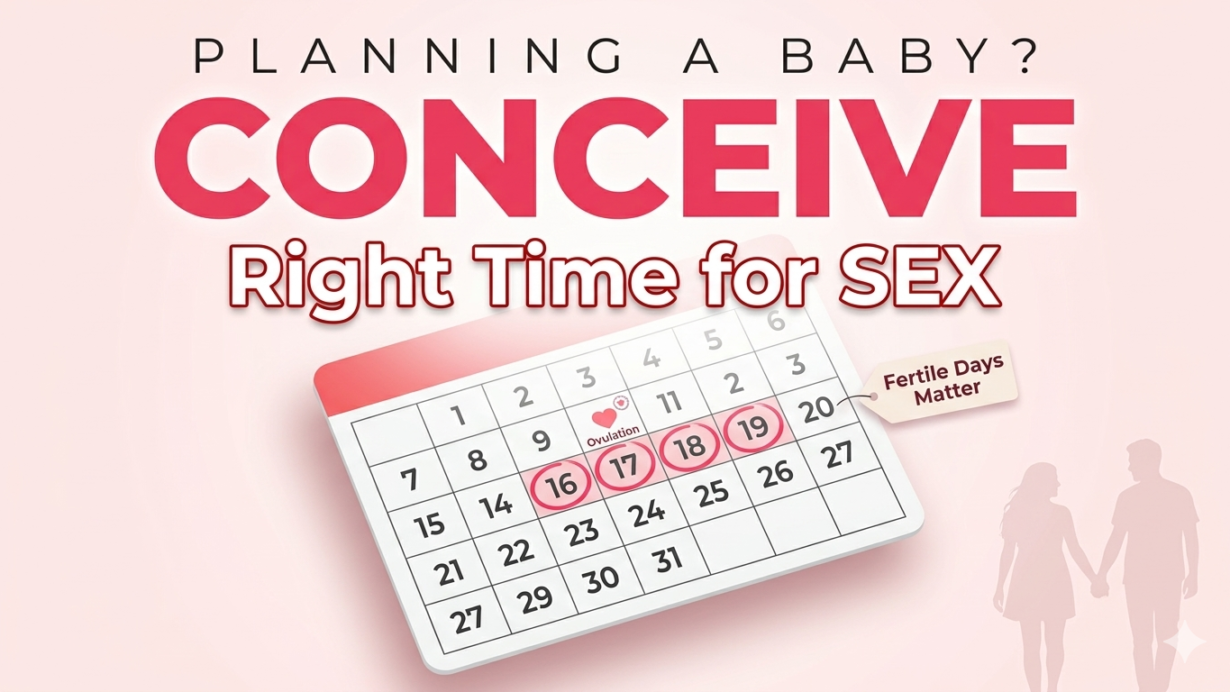
If you are trying to conceive, you have probably heard the same phrases: “Just relax” or “It will happen when it’s meant to.” But for couples navigating fertility, timing is not about luck—it is about understanding your body’s rhythm.
We spoke with Dr. Sakshi Chopra, Consultant IVF, Kailash Deepak Hospital, to get science-backed answers on when to have sex for the best chance of conception—and how insights from IVF can help couples trying naturally.
The Window Is Smaller Than You Think
Here is a biological reality that surprises most couples: an egg survives for only 12 to 24 hours after ovulation. Sperm, on the other hand, can live inside the female body for up to five days—but only if fertile-quality cervical mucus is present.
This means your true fertile window is not a single day. It is a stretch of about six days: the five days before ovulation and the day of ovulation itself. The goal is not to wait for ovulation to happen. The goal is to have sperm already waiting when the egg arrives.
“Many couples focus entirely on the day they think they ovulate,” explains Dr. Sakshi Chopra, Consultant IVF, Kailash Deepak Hospital. “But by that time, they might have already let their best chance slip away. The real precision comes from recognizing the signs that ovulation is about to occur.”
Reading Your Body’s Natural Signals
Your body gives you clear signals when you are entering your fertile window. Learning to recognize them is the most effective way to time intercourse without stress or guesswork.
The first signal is your cervical mucus. In the days leading up to ovulation, rising estrogen causes your mucus to change. It becomes clear, slippery, and stretchy—similar to raw egg whites. This is nature’s way of creating the ideal environment for sperm to swim and survive. When you notice this change, your fertile window is open. This is the time to begin having intercourse.
The second signal is the LH surge. Luteinizing hormone (LH) surges approximately 24 to 36 hours before ovulation. This is the same hormonal trigger that IVF specialists track with precision during treatment cycles. At home, you can detect this surge using simple urine test strips. Once you see a positive result—where the test line is as dark or darker than the control line—ovulation is approaching. Intercourse should begin that day and continue for the next two to three days.
The third signal is basal body temperature. After ovulation, your temperature rises slightly and stays elevated until your period. This method does not predict ovulation in real time, but it helps you understand your cycle pattern over several months. Once you know your pattern, you can anticipate your fertile window with greater accuracy.
Also Read : IVF Treatment Step by Step: What Couples Should Know Before Starting
Common Timing Mistakes Couples Make
Even with the best intentions, many couples fall into patterns that unintentionally reduce their chances.
One common mistake is relying solely on mobile apps. Apps are convenient, but they work on averages—not your personal cycle. Ovulation can shift by several days from month to month, and an app cannot predict those changes.
Another mistake is waiting for a positive ovulation test before having sex. While the test confirms the surge, waiting until that moment means you lose the valuable days leading up to it when sperm can already be in place.
Some couples also make the error of having sex only once during the fertile window, assuming that one well-timed encounter is enough. In reality, having intercourse every day or every other day during the fertile window increases the chances that healthy sperm will be present exactly when the egg is released.
And perhaps the most overlooked mistake is letting the pressure of timing drain the intimacy from the process. Stress can delay ovulation and affect sperm quality. The goal is to be intentional—not mechanical.
What IVF Teaches Us About Timing
At Kailash Deepak Hospital, specialists like Dr. Sakshi Chopra work with couples undergoing IVF, where timing is measured in hours rather than days. The same principles that guide IVF cycles—tracking hormone surges, monitoring cervical changes, and understanding the lifespan of eggs and sperm—can be applied to couples trying to conceive naturally.
“One of the most valuable insights from IVF is that preparation matters more than reaction,” says Dr. Sakshi Chopra. “In an IVF cycle, we don’t wait for the egg to release. We prepare the body, track every sign, and time the retrieval with precision. Couples trying naturally can adopt the same mindset. Watch for the signs. Start early. And give yourself the full window.”
When to Move Beyond Timing
If you have been tracking your cycle accurately and having well-timed intercourse for six months to a year—or six months if the woman is over 35—and pregnancy has not occurred, it may be time to seek a fertility evaluation.
“Timing is a powerful tool, but it is not a solution for underlying medical conditions,” explains Dr. Sakshi Chopra, Consultant IVF, Kailash Deepak Hospital. “At Kailash Deepak Hospital, we offer complete fertility assessments to identify issues such as hormonal imbalances, blocked tubes, or male factor infertility. Sometimes the missing piece is not better timing—it is a clearer understanding of what is happening beneath the surface.”
Final Thoughts
Trying to conceive can often feel like wandering through a maze without a map. But the truth is, your body provides the map. By learning to recognize your fertile signs and timing intercourse with intention rather than pressure, you give yourself the best possible chance.
And if the journey becomes longer than you hoped, you don’t have to walk it alone. With experts like Dr. Sakshi Chopra at Kailash Deepak Hospital, you have access to both the wisdom of natural fertility and the precision of advanced reproductive care.