There is a moment in every couple’s journey when hope and science need to sit down at the same table. If you have been trying to conceive without success, you may have arrived at that moment. The term IVF treatment might have been floating around your conversations—whispered between family members or suggested by your gynecologist.
“Patients often come to me with a lot of information from the internet, but they lack the ‘insider view,'” says Dr. Monika Gupta, IVF Specialist, Kailash Hospital. “Knowing the rhythm of the treatment helps you sync your mind and body with the process. At Kailash Hospital, we focus on turning that anxiety into informed action.”
Also Read : How to Improve Egg Quality for IVF Naturally: Expert Tips by Dr. Monika Gupta
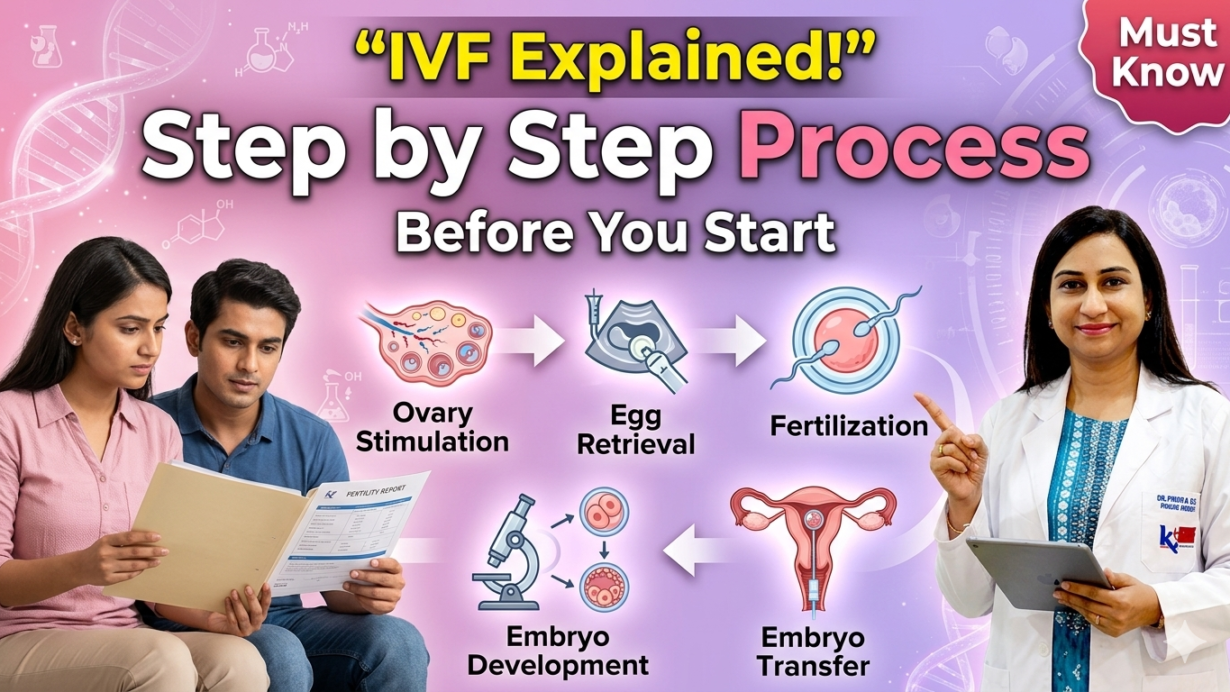
Here is the step-by-step reality of IVF
Phase 1: The Deep Dive (Initial Consultations)
Before a single medication is prescribed, you must undergo a complete diagnostic audit. This isn’t just a casual blood test; it is a deep dive into your reproductive health.
For the woman, this involves an Antral Follicle Count (AFC) via ultrasound and hormonal profiling (AMH, FSH, LH). For the man, an advanced semen analysis looks beyond just count—it examines DNA fragmentation and morphology. “Many couples skip this step or rush it,” warns Dr. Monika Gupta. “But a rushed start often leads to a failed cycle. We take our time here at Kailash Hospital to ensure we aren’t missing any hidden barriers.”
Phase 2: The Orchestra of Hormones (Ovarian Stimulation)
Once the green light is given, the woman enters the stimulation phase. Think of this as conducting an orchestra. Instead of the usual single egg performance, you are trying to get a full symphony of eggs to play together.
For 10 to 12 days, you will administer self-injections. These are not painful, but they require precision. You will visit the clinic every other day for “monitoring”—a quick ultrasound to count the growing follicles (the fluid sacs holding the eggs). It is a period of fluctuating emotions, as the hormones can make you feel tired or bloated.
Phase 3: The Silent Procedure (Egg Retrieval)
The egg retrieval is often the scariest part for couples to imagine, yet it is the most peaceful part of the IVT treatment cycle.
You will be placed under light sedation. You drift off to sleep, and when you wake up 20 minutes later, the procedure is done. A thin needle, guided by ultrasound, has passed through the vaginal wall and aspirated the eggs from the follicles. It is done on an outpatient basis—you go home the same day, resting with a heating pad.
Phase 4: The Lab Dance (Fertilization)
While you rest, the real magic happens in the embryology lab. The embryologist combines the healthiest sperm with your mature eggs.
In some cases, where the sperm has difficulty penetrating the egg, the embryologist performs ICSI (Intracytoplasmic Sperm Injection), manually injecting a single sperm into the egg. Over the next 24 hours, they will look for signs of fertilization—two tiny nuclei, called pronuclei, appearing in the egg. This is the first proof that life is beginning.
Phase 5: The Waiting Game (Embryo Culture)
Now comes the waiting. The embryos are kept in incubators that mimic the fallopian tubes. They will be checked on Day 3 (when they are usually 6-8 cells) and again on Day 5.
Not all embryos survive to Day 5. This is nature’s quality control. The ones that reach the “blastocyst” stage on Day 5 or 6 are the strongest candidates. This is often when genetic testing (PGT-A) might be discussed if you are at risk for chromosomal disorders.
Phase 6: The Transfer (The Journey Home)
The embryo transfer is the opposite of the retrieval—it is simple, painless, and deeply emotional. You are awake, and often your partner can be in the room.
Using a soft catheter, the doctor guides the embryo(s) through the cervix and into the uterine cavity. “At Kailash Hospital, we use ‘soft transfer’ techniques,” explains Dr. Monika Gupta. “We believe the gentler the transfer, the higher the chance of implantation. We show the embryo on the ultrasound screen to the parents before we transfer it. That moment of seeing the tiny ‘flash’ where their baby will hopefully grow is priceless.”
Phase 6.5: The Lunar Wait (The Two Weeks)
After the transfer, you enter what is medically known as the “luteal phase,” but is emotionally known as the “two-week wait.”
You will take progesterone supplements to keep the uterine lining thick and receptive. This period is a rollercoaster. Every twinge is analyzed. Every mood swing is questioned. It is vital to have a support system in place during this time—whether that’s your partner, a therapist, or a support group.
Phase 7: The Verdict (Pregnancy Test)
Approximately 12 to 14 days after the transfer, you return for a beta-hCG blood test. This measures the pregnancy hormone.
If it is positive, you will repeat the test 48 hours later to ensure the levels are rising correctly. If it is negative, it is a devastating blow. However, a negative cycle is not the end. It provides data. It tells the doctor what to adjust for the next attempt.
Preparing for the Journey
Undergoing IVF treatment is not just a medical procedure; it is a lifestyle. It requires financial planning, emotional resilience, and physical stamina.
Choosing the right environment matters. At Kailash Hospital, the integration of advanced embryology labs with compassionate counseling ensures that couples never feel like they are on a conveyor belt. Under the guidance of experts like Dr. Monika Gupta, you are given a roadmap, but you are also given the freedom to ask questions, pause, and breathe.