
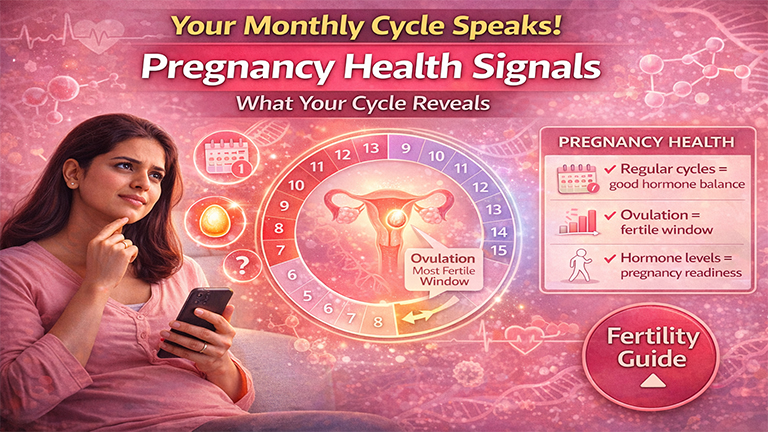
For many women, the menstrual cycle is often viewed as a monthly inconvenience rather than what it truly is: a vital sign, much like your pulse or blood pressure. It is your body’s primary method of communicating its internal health status. When planning for a baby, understanding this communication becomes the foundation of a healthy lifestyle during pregnancy and conception. Often, the clues that determine a smooth journey into motherhood are hidden in the patterns of cycles you’ve had for years.
We spoke with Dr Monika Gupta, Fertility & IVF specialist, Kailash Hospital, to decode these signals. “The menstrual cycle is a window into your hormonal balance and ovulatory health,” explains Dr. Gupta. “Ignoring irregularities is like ignoring the ‘check engine’ light in your car. By the time you are pregnant, addressing those issues becomes more complex.”
The Rhythm as a Roadmap
A regular menstrual cycle (typically between 21 to 35 days) suggests a symphony of hormones working in harmony. However, when the rhythm is off, it provides specific health clues you shouldn’t ignore, especially if you are planning to conceive.
- The Irregular Beat: Cycles that are consistently longer than 35 days or incredibly short may indicate anovulation (not releasing an egg). This is a direct barrier to conception and a sign that the healthy lifestyle during pregnancy you hope to achieve needs to start with medical intervention first.
- The Pain Factor: While mild discomfort is common, severe, debilitating pain (dysmenorrhea) that requires you to miss work or school is not “just part of being a woman.” It can be a sign of underlying conditions like endometriosis or fibroids, which can impact fertility and pregnancy safety .
Red Flags on the Path to Motherhood
According to Dr Monika Gupta, Fertility & IVF specialist, Kailash Hospital, paying attention to the following menstrual health clues can significantly alter your prenatal outcomes:
- Heavy Bleeding (Menorrhagia): Soaking through pads or tampons every hour, or passing large clots, can be a sign of hormonal imbalance, polyps, or fibroids. These conditions can create a hostile environment for implantation or increase the risk of miscarriage.
- Missed Cycles (Amenorrhea): Skipping periods for months at a time (and not being pregnant) is a clear signal that ovulation has stopped. This is often linked to Polycystic Ovary Syndrome (PCOS), extreme stress, or thyroid issues.
- Mid-Cycle Spotting: Bleeding between periods could indicate low progesterone levels or structural issues with the cervix or uterus. Progesterone is the hormone that sustains the uterine lining during early pregnancy; low levels can make maintaining a pregnancy difficult.
Building a Healthy Lifestyle During Pregnancy: Start Before the Bump
Many women wait until they see a positive test to adopt a healthy routine. However, Dr Monika Gupta emphasizes that “Prenatal care begins in the preconception phase.” At Kailash Hospital, we often see that addressing menstrual health clues six months before conception leads to healthier pregnancies and easier deliveries.
Here is how you can align your lifestyle with your cycle:
- Nutrition Sync: In the week after your period (the follicular phase), estrogen rises. This is when your body is most efficient at using carbs for energy. Focus on complex carbohydrates and iron-rich foods to replenish what was lost during menstruation.
- Listen to the Luteal Phase: The week before your period (luteal phase), progesterone rises, which can cause bloating and cravings. This is a time for anti-inflammatory foods, magnesium, and reducing sodium to ease PMS symptoms. Managing PMS effectively through diet is a cornerstone of a healthy lifestyle during pregnancy preparation, as it stabilizes your metabolic health.
Also read : PCOS और Infertility: क्या हर PCOS मरीज को IVF की जरूरत होती है?
When to Knock on the Specialist‘s Door
Time is of the essence when it comes to fertility. If you are under 35 and have been trying to conceive for a year with irregular cycles, or over 35 for six months, it is time to seek expert advice .
Facilities like Kailash Hospital are equipped with state-of-the-art diagnostic tools to investigate the health clues your body is providing. “We use detailed hormonal assays and ultrasounds to map out the cycle,” says Dr. Gupta. “Sometimes, the issue is as simple as a thyroid imbalance, which is easily corrected with medication, paving the way for a textbook healthy lifestyle during pregnancy.”
The Takeaway
Your menstrual cycle is not just about fertility; it is a lifelong report card of your endocrine health. By respecting the health clues it provides, you empower yourself to take control of your reproductive future. Whether it’s regulating your diet, managing stress, or consulting a specialist at Kailash Hospital, every step taken to normalize your cycle is a step toward a safer, healthier pregnancy.
As Dr Monika Gupta, Fertility & IVF specialist, Kailash Hospital, aptly puts it, “In the journey of conception, your menstrual cycle is the map. Don’t throw it away and hope for the best. Learn to read it, and it will lead you to your destination.”