
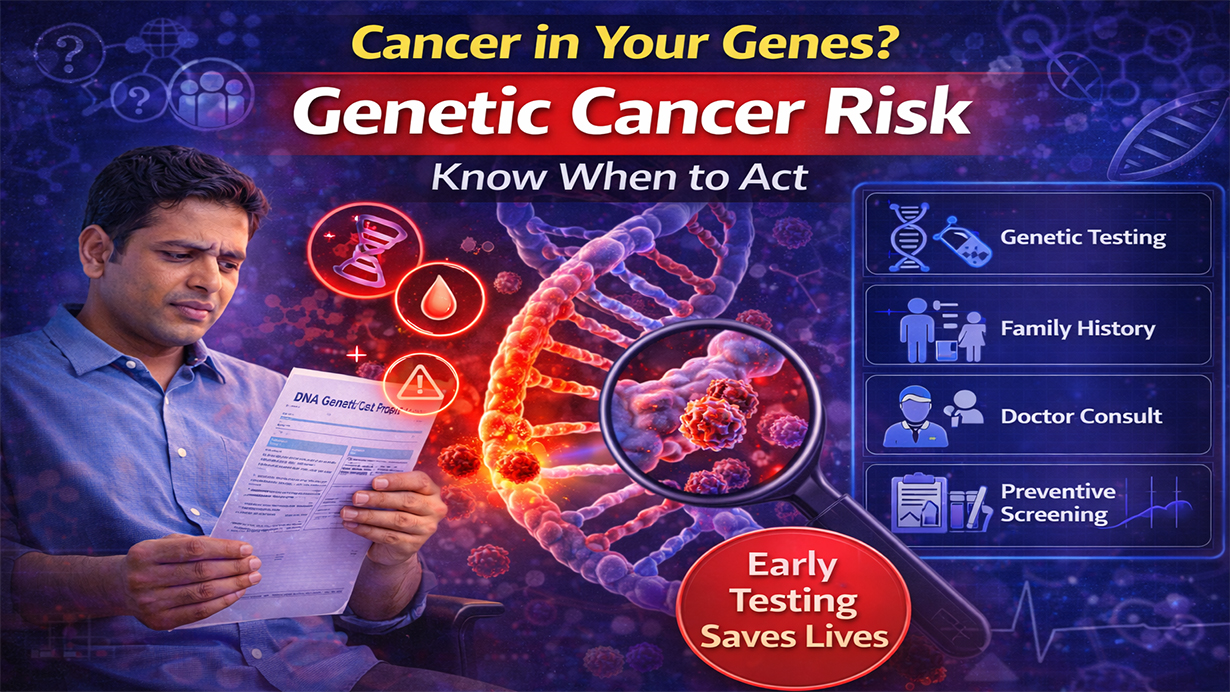
For decades, the conversation around cancer risk began and ended with family history. If your mother had breast cancer or your father had colon cancer, you were vaguely aware that you might be at a slightly higher risk. However, modern oncology has shifted its focus to a much more precise science: genetics. We now understand that the blueprint of our DNA often holds the answers to why some families are more prone to certain cancers and, more importantly, what we can do about it.
Understanding the role of genetics in cancer is not about living in fear of your DNA; it is about empowerment. By identifying a hereditary cancer predisposition, you can take proactive steps toward surveillance and prevention. To shed light on this critical topic, we spoke with Dr. Sourabh Mukharjee, Sr. Consultant Surgical Oncology at Kailash Deepak Hospital, who explains that “knowledge of your genetic makeup is the strongest weapon we have in the war against cancer.”
The Blueprint of Susceptibility: Not All Cancers Are Created Equal
It is crucial to understand that not all cancers are hereditary. In fact, the majority are sporadic, meaning they occur due to aging or environmental factors. However, approximately 5% to 10% of all cancer cases are directly linked to inherited genetic mutations.
We all carry tumor suppressor genes—such as BRCA1, BRCA2, and APC—that act as the body’s first line of defense, repairing damaged DNA and preventing cells from growing uncontrollably. A pathogenic variant (or mutation) in these genes is like a blueprint with a critical flaw. It significantly increases an individual’s cancer susceptibility.
For example, a landmark study conducted in India highlighted the discovery of a never-before-seen mutation in the APC gene affecting a large family in Gujarat. This mutation left them highly susceptible to Familial Adenomatous Polyposis (FAP), a condition where hundreds of polyps grow in the colon, eventually turning malignant if left untreated.
Red Flags: Who Should Consider Genetic Counseling?
One of the most common questions asked at Kailash Deepak Hospital is, “Should I get a genetic test?” According to Dr. Sourabh Mukharjee, the decision to undergo cancer genetic testing should be guided by specific “red flags” in your personal or family medical history. You may be a candidate for germline genetic testing if you have:
- Early-Onset Cancer: A diagnosis of cancer at an unusually young age (e.g., breast cancer before 45 or colorectal cancer before 50).
- Multiple Generations: The same type of cancer appearing in multiple generations of your family (grandparent, parent, and child).
- Rare Cancers: A diagnosis of a rare cancer, such as male breast cancer or ovarian cancer, which is strongly linked to genetic mutations.
- Multiple Primary Cancers: An individual who has had two different types of cancer (like bilateral breast cancer or both colon and uterine cancer).
- Ethnicity: Certain ethnic populations, such as those with Ashkenazi Jewish ancestry, have a higher prevalence of specific inherited gene mutations.
The Power of the Panel: How Testing Works Today
Gone are the days when genetic testing meant checking just one gene at a time. Today, multigene panel testing has revolutionized the field. Using a simple blood sample, laboratories can now sequence multiple genes simultaneously to look for alterations that indicate a higher risk.
Dr. Sourabh Mukharjee emphasizes the clinical benefits of this approach: “Testing isn’t just about identifying risk; it directly impacts treatment. For patients with certain mutations, we can determine eligibility for targeted therapies like PARP inhibitors, which are specifically designed to attack cancer cells with defective DNA repair mechanisms.”
If a test reveals a pathogenic variant, it allows for a personalized medical plan. This might include earlier and more frequent screenings (like colonoscopies or mammograms), risk-reducing medications, or even prophylactic surgeries to prevent cancer before it starts.
Also read : Understanding Anal Cancer: Early Warning Signs and Modern Care
The Importance of Genetic Counseling
While the technology is advanced, the decision to test is deeply personal. This is why genetic counseling is an essential part of the process, not just an optional add-on. Before the test, a counselor or specialist helps you understand the potential outcomes—including the possibility of receiving a Variant of Uncertain Significance (VUS), which means the lab found a change in your gene but doesn’t yet know if it causes cancer.
Furthermore, a positive test result has implications for your entire biological family. It opens the door for cascade testing, where relatives can be tested for the specific family mutation to understand their own risk.
Conclusion
Your family history is your story, but your genes do not have to dictate your future. With advances in genetic technology, we have the power to intercept cancer before it gains a foothold. If your family history includes the red flags mentioned above, it may be time to have a conversation with an expert.
Understanding the role of genetics in cancer is the first step toward taking control of your health. At Kailash Deepak Hospital, experts like Dr. Sourabh Mukharjee are leading the charge in using this information to save lives—one genetic blueprint at a time.